
88% of Organisational Transformations Fail

Vikram Korde
Vikram has extensive experience as a global marketing leader in well-known blue-chip FMCG companies leading billion-dollar brands and innovation-driven retail organizations. His philosophy to deliver results : Be Agile, Be customer-obsessed, Follow the evidence & Be creative
Why Organisational Transformations Fail
Organisations love using the word transformation.
Boards love it.
CEOs declare it.
Consultants package it.
Employees tolerate it.
And after all that excitement; after the town halls, the workshops, the motivational wall prints, and the obligatory “transformation roadmap” PowerPoint, the outcome is almost always the same: the slow slide back to the old world, accompanied by a final report so diplomatically worded that no one can quite tell whether anything happened at all.
Numbers don’t lie.
Harvard Business Review reports that only 12% of organisational transformations create meaningful, sustained impact. That leaves 88% that either fall apart or quietly deliver something so underwhelming everybody just pretends it was a “learning experience.”
For transformations across all companies that cost millions to promote change the way they operate, that’s a pretty abysmal rate of return. Not only that, it’s a blow to the credibility of the people who propose that change. But the real story isn’t even about the rate of failure. That is old news.
The real story is the pattern. The fact that organisations fail in the same predictable ways, year in and year out, across industries, continents, and management fashions is fascinating. If transformation were a university exam, most companies would be repeating the same module for the seventh consecutive year.
So, let’s drop the glitter and get to the substance.
Why do transformations fail? More importantly, what would it take to join the 12% that constitute the rare group of people who actually cross the finish line with something to show for it?
The Illusion of Transformation
“Transformation” has become corporate’s version of horoscopes: it’s vague enough to mean anything you want it to, flexible enough to apply to anyone, and popular enough that nobody questions it. It is used for anything from tweaking the HR operating procedure to redesigning an entire global value chain. The ambiguity is the problem: when a word is stretched to cover every scenario, it stops meaning anything at all.
This is why so many organisations embark on transformations for reasons that have very little to do with strategy. These reasons could be:
- We do it because competitors are doing it.
- The board wants to appear modern.
- A new CEO wants to put his fingerprints on the company.
- The consultants convinced the board with a 300-slide deck explaining why now is the moment.
- “Transformation” sounds heroic, while “fixing persistent operational issues” does not.
Transfiormation by itself is not a strategy. It is a delivery mechanism; a tool. It is the means to an end, not the end.
Why organisational transformations fail is not a mystery, because, when that strategy is muddy, vague, defensive, or politically sanitized, the transformation attached to it wanders aimlessly. And wandering is expensive. Eventually the programme collapses under its own weight, leaving behind a trail of partially completed initiatives, exhausted employees, and a fresh appetite for the next big transformation. Which is often launched by the same people who quietly buried the last one.
Despite genuine optimism, why do 88% of the Transformations Fail
Contrary to popular belief, why organisational transformations fail is not because organisations are lazy or cynical. Most begin with genuine optimism. Senior leaders sincerely believe they are reinventing the organisation. People attend the kickoff with real hope. The slides look polished. The language is bold.
But beneath the surface, the same structural patterns appear. These patterns have nothing to do with intention and everything to do with design.
- The ambition is too small to matter
Most changes are just incremental, but, dressed up as revolutionary.
The ambition is framed in safe language: cost is shaved here, efficiency is nudged there, a process is streamlined, a dashboard is refreshed, a new role is created three levels down in the organisation, and all of that is then packaged as “next-generation reinvention.”
Meanwhile, the real opportunities remain untouched: new markets, new revenue engines, new operating models, new customer experiences. The company sets a target so modest that even hitting it would make little difference.
Small ambition produces small energy –>Small energy produces small change –> Small change does not survive long enough to matter.
- Change is designed by the top, delivered at the bottom, and adopted by neither

This is the classic corporate choreography.
A few senior leaders design a blueprint.
Middle managers are tasked to “execute with urgency.”
Employees are told that they should feel excited.
Each layer assumes that somebody else will make it work.
Every layer is secretly doubting it.
This model is grounded in assumptions that are outdated: The leader knows all the answers; the manager need only “drive accountability”; the employees will change because a slide says they must; and the old culture is something that lingers along after a new formal structure is implemented. If it were not sad, it would be hilarious.
But employees change only when they understand why the change is happening, when they can picture themselves in the future state, when they believe the change improves their odds of winning, and when they feel trusted to participate in it. Employees not buying into the new vision is one of the biggest and most important reasons for what organisational transformations fail.
Transformation is not powered by executive declarations; it’s powered by energy, and energy is released only when people across the organisation shape the journey rather than are told to salute it.
- Leadership behaviour doesn’t change
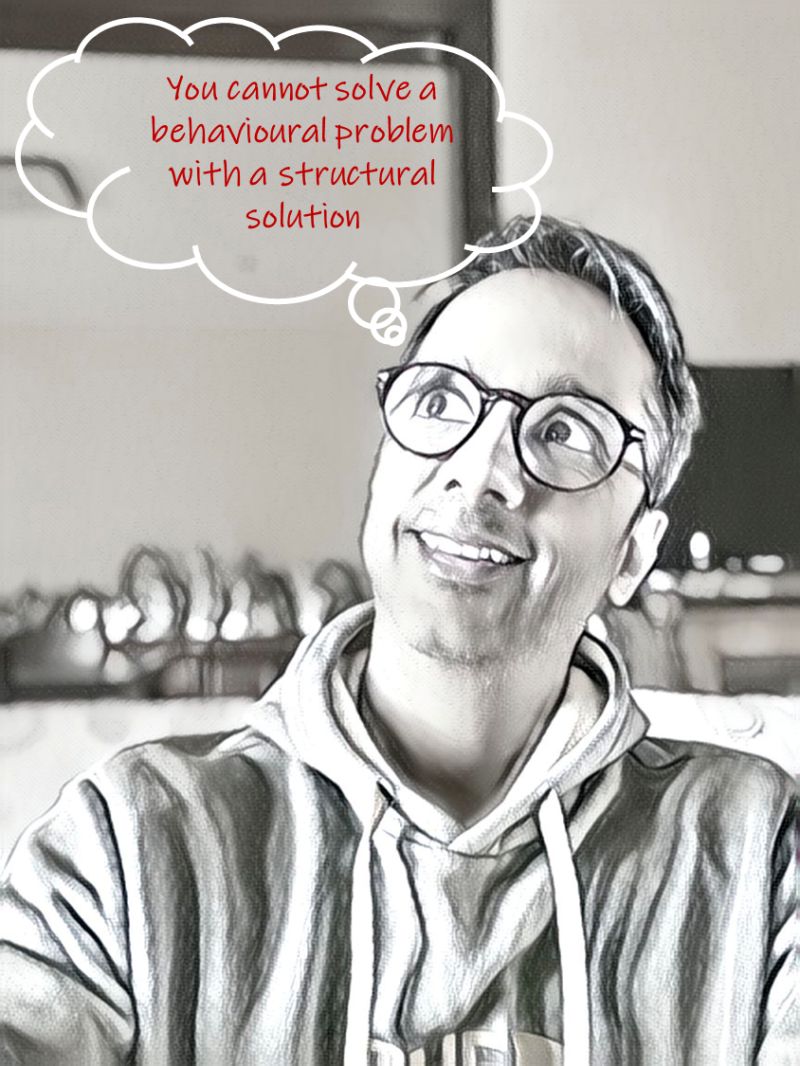
You can redesign operating models, decision rights, governance structures, role descriptions and process flows until your servers beg for mercy. Nothing will change if leadership behaviour stays the same.
An organisation goes at the speed of its leaders.
If leaders act as if they can micromanage, avoid risk, hoard decisions, protect turf, and behave as though change is optional, the transformation becomes a stage play which is convincing during rehearsals but is unwatchable in real performance.
Successful transformations require leaders to adopt new routines and symbols, to demonstrate new norms in decision-making, to show visible alignment, and to change not only what they do but how they do it. Why many organisational transformations fail is because leaders assume their job is to announce the future, not model it.
This is one of the most frequent and expensive mistakes: positioning transformation as a parallel universe. This universe has everything: It gets its own governance and budgets. They are judged by a different set of KPIs. They maintain a distinct rhythm of communication. And the all-powerful PMO lives in a polished glass annex far away from the messy reality of everyday operations.
This separation is deadly. Where transformation sits next to the business and not inside it, it becomes theatre. It is impressive in presentation but irrelevant in impact.
It only succeeds when transformation is woven into the way the company already runs: planning, budgeting, performance management, decision meetings, talent processes, and weekly routines. When these systems remain untouched, the transformation is a temporary visitor who is visible for a while, forgotten when the real work resumes.
- The transformation occurs to the people, not through the people
People do not resist change.
They resist being changed without involvement.
Most transformations operate with opaque decision-making, top-down communications, ceremonial updates, and a tacit expectation for employees to adapt.
People accept change when they feel that they are part of the process and design as well as being a part of the decision and having part of the ownership.
People resist change when they feel judged, excluded, or treated as passive recipients.
The reason least admitted for why organisational transformations fail is that it is a vanity project for the leader or the leadership team. Take away the vanity and make it a collective creation, which will speed up its acceptance.
The Four Conditions of Successful Organizational Transformation
And despite the grim statistics, successful transformations do exist and they share common DNA. They are not louder or more dramatic than the failed ones. They are simply more grounded, more courageous, and more integrated into the way the organisation actually works.
- Be Highly Aspirational
Ambition is not a decoration; it’s fuel.
A transformation has to spell out a future that is unmistakably better than the present; a future that gives people a reason to move. This isn’t about fantasy. It’s about clarity:
- What are we building?
- What will dramatically shift?
- How will we win?
- Why does it matter now?
People don’t commit to chores. People commit to meaning.
A worthy ambition builds momentum long before the first process map is drawn.
- Energize the Transformation with Employees
Transformation launched from the top slows down and shuts down quickly.
The transformation carried by the organisation sustains itself.
Energy comes from participation, transparency, autonomy, and the psychological safety to speak honestly. People commit when they are invited in to shape, challenge, and influence the direction. When they feel seen.
Top-down push is limited and brittle.
Bottom-up pull is resilient.
- Anchor the Change in Leadership Behaviour
Leaders are the first movers.
If they don’t step into the new system, nobody else will.
That means making quicker decisions, empowering rather than bottlenecking teams, removing legacy processes, rewarding experimentation, and confronting misalignment early. And it requires a dose of humility, too: the willingness to say “I don’t know,” to listen, and to adjust.
Transformations die the moment leaders retreat into old habits under pressure. They succeed when leaders evolve before asking anyone else to.
- Make Transformation Part of the Management Process
A transition reliant upon a stand-alone programme office will inevitably wither.
A transformation that becomes the operating model will last.
It means targets flowing into annual plans, KPIs tied to performance reviews, budgets aligned with the new priorities, decision forums redesigned or abolished, and routines embedded across weeks, months, and quarters.
In other words, the transformation ceases to be a special initiative and becomes the system itself.
Why Organisations Repeat Failed Transformations
If transformations fail at such a high rate, why do organizations keep launching them?
Without internal transformation capability, every leadership change or market shock creates the same reaction: “Let’s transform.”
Repeated attempts at transformation despite past failures could have several reasons behind them. Many times a new CEO shows up and begins touting their “new direction.” Or, it is externally motivated: a competitor makes their move, and all of a sudden, everyone wants to “rethink the operating model.” Then come the consultants who repackage familiar concepts with new labels.
Failure is accelerated even more when employees leave, taking institutional memory with them.
And the cycle repeats. Transformation becomes more of a recurring patch rather than an actual upgrade.
The organisation continuously installs new software on old hardware.
The Way Forward: Transformation That Actually Works
A transformation that works is never the noisiest, the biggest or most theatrical.
It is the one that is:
- Clear in its ambition
- Co-created rather than broadcast
- Led rather by leadership behaviour than by leadership slogans
- Embedded into the daily management rhythm, as opposed to floating beside it
It is humble enough to know that culture does not bend to PowerPoint.
Disciplined enough to redesign the systems that actually run the company.
Courageous enough to challenge the behaviours that hold the organisation back.
Most importantly, it recognises that transformation is not a project with a closing date.
It is a way of thinking, deciding, behaving, and operating, in short, A permanent capability, not a temporary programme.
This is what 12% understand.
The remaining 88% confuse movement for progress and noise for change.
Sources
- Bain & Co. : Why 88% transformations fail
- McKinsey & Company : Why Digital Transformation Fails


Why AI Use Cases Fail Without an Enterprise AI Operating Model.
Most AI programmes deliver isolated efficiency gains but fail to improve customer experience. The missing link is an enterprise AI operating model that connects internal activity chains to external outcomes.

Does AI Adoption Require Restructuring Your Organization?
AI adoption often does require restructuring, but not in the way most leaders think. The real shift is not org chart theatre. It is workflow redesign, clearer decision rights, stronger governance, and roles built for human and AI collaboration.

If you automate a bad workflow and cannot troubleshoot it, AI transformation will fail!
A failed CSV upload is not a small technical issue. It reveals two deeper problems: the workflow may never have been designed properly, and the organisation may no longer know how to troubleshoot when automation fails.