
Does AI Adoption Require Restructuring Your Organization?

SAKET BIVALKAR
Saket Bivalkar is the Managing Partner of Versatile Consulting, a boutique consultancy that designs operating models for multinationals. His work focuses on building models that hold across geographies while allowing for local adaptation. Recent engagements include 63-country and 42-country operating model transformations in regulated industries.
He is based in Spain and can be reached at saket@versatile.consulting.
About Saket Bivalkar
Does AI transformation Require Restructuring Your Organization?
For many leadership teams, this question arrives too late.
By the time they ask it, they have already bought the tools, launched pilots, assigned someone to “look into AI,” and told the business that transformation is underway.
What they have not done is redesign how work actually happens.
That is the real issue.
Integrating AI in any work process often does require restructuring your organization. But not in the simplistic sense most executives imagine. This is rarely about moving boxes on an org chart first. It is about redesigning workflows, decision rights, governance, team interfaces, and management practices so AI can create value without creating confusion.
” Because many organizations are still trying to fit AI into operating models built for manual coordination, siloed functions, fragmented data, and slow human handoffs, they generate activity without enterprise impact. McKinsey’s 2025 global survey found that redesigning workflows has the biggest effect on whether organizations see EBIT impact from gen AI use, and only 21% of respondents said their organizations had fundamentally redesigned at least some workflows.” Source : Mckinsey & Co, State of AI report

The short answer
If your use of AI is limited to lightweight productivity support, you may not need major structural change yet.
If you want AI to improve speed, cost, quality, control, customer experience, or decision-making at scale, then parts of your organization will need redesign.
That redesign usually happens in five places:
- workflows and processes
- roles and responsibilities
- governance and decision rights
- team structure and ownership
- leadership expectations and workforce capability
This is where AI transformation becomes real.
Why the current organization often blocks AI value
Most companies do not fail with AI because the model is weak.
They fail because the organization around the model is unprepared.
A workflow spans five functions, but no one owns the full outcome.
A team automates a step, but the upstream data is broken.
A business unit launches an AI use case, but governance sits somewhere else.
A manager expects productivity gains, but nobody has rewritten the role.
Legal wants control, operations wants speed, technology wants standards, and no one has resolved the trade-offs.
The result is predictable. AI gets inserted into fragmented work instead of reshaping it.
That is why the first design question should not be, “What tool should we use?”
It should be, “How is value created across this workflow today, where does it break, and what changes when AI can recommend, draft, automate, or act?”
That is operating model work.
An operating model is not an org chart, a target-state slide, or a process library. It is the system that turns strategy into repeatable execution through workflows, people, decision rights, technology, and performance management. Source : Operating Model for AI
1. Workflow redesign comes before automation
This is where many organizations get the sequence wrong.
They start by asking where they can apply AI.
They should start by asking how the end-to-end workflow creates value, where the delays are, where the handoffs break, where judgment is essential, and where exceptions keep forcing people back into manual work.
If you automate a weak workflow, AI will scale the weakness.
This is also why failed automation is rarely just a technical incident. When something as simple as a CSV upload breaks and the team has no way to troubleshoot it, the issue is bigger than the upload. It reveals a weak workflow design and an organization that has confused automation with operational capability.
That means leaders need to examine:
- end-to-end process flow
- approval layers
- points of rework
- data dependencies
- human validation points
- exception handling
- escalation paths
- ownership for outcomes
If this is not done first, AI becomes another layer sitting on top of a broken system.
2. Roles need to be rewritten, not defended by habit
There is still too much weak thinking on this topic.
Some leaders talk as if AI means wholesale replacement. Others act as if no meaningful role redesign is needed. Neither position is serious.
What AI changes first is the composition of work.
Execution-heavy tasks are reduced. Judgment, supervision, exception handling, orchestration, validation, and cross-functional coordination increase in importance.
In a scalable hybrid operating model, accountability has to become explicit. The core roles may differ by company, but the underlying responsibilities do not: business ownership, workflow ownership, prioritization, evaluation and drift monitoring, risk and compliance, and human supervision.
This is where many organizations drift into ambiguity.
The tool is live. The outputs are moving. But nobody has clearly decided who owns the business outcome, who owns workflow integrity, who owns evaluation, who approves changes, who pauses the capability, and who is accountable when the system performs badly.
When those questions remain vague, AI does not create a modern organization. It creates confusion at higher speed.
3. Governance has to move from policy language to operating reality
Many organizations say they care about responsible AI.
Far fewer have translated that into operating reality.
Who approves a use case for production?
Who defines where human review is mandatory?
Who owns model risk?
Who decides which data sources are acceptable?
Who handles incidents?
Who monitors performance drift?
Who can stop or retire a live capability?
Governance is not a side document. It has to be part of the operating model.
AWS’s operating model guidance is useful here because it makes the trade-off explicit: business units may drive use cases, while a central team governs guardrails, model risk management, data privacy, and compliance posture in a federated setup. Source : AWS Operating Model Guidance.
That same logic is reflected in the practical decision-rights model for AI operating models: approve the use case, approve data sources and access, approve release to production, pause or roll back in production, and retire the capability with proper logs and traceability.
That is the level leaders need to operate at.
Not “we have an AI policy.”
But “we know exactly who decides what, when, and under which conditions.
4. Team structure has to shift toward outcomes, not functions alone
Traditional organizations are usually built around functions.
AI creates pressure around workflows.
Customer onboarding does not sit in one department.
Claims handling does not sit in one department.
Order-to-cash does not sit in one department.
Employee service delivery does not sit in one department.
These are cross-functional systems.
That is why the most important restructuring for AI is often not a grand reorganization. It is clearer ownership of end-to-end outcomes.
If no team owns the outcome across the workflow, AI will not repair the coordination failure for you.
A hybrid operating model is useful here because it forces the organization to define where AI recommends, where it drafts for approval, where it can execute within guardrails, and how humans remain accountable inside the workflow.
That is a more serious design choice than simply giving functions new tools.
5. Capability building is not optional
AI adoption changes the tools people use.
More importantly, it changes the kind of competence the organization needs.
Teams need to understand how to work with non-deterministic outputs. Managers need to know when to trust, when to review, and when to escalate. Process owners need to recognize when a workflow is not ready for automation. Leaders need to understand that AI value depends on design quality, not enthusiasm.
That is why capability building has to move beyond generic AI literacy.
It needs to include:
- workflow thinking
- exception handling
- judgment under automation
- risk awareness
- human oversight design
- troubleshooting
- escalation discipline
- performance monitoring
A credible AI readiness approach starts with real work, real decisions, and real pain points. It maps workflows, decisions, and bottlenecks using data, documents, and interviews, then uses Digital Twin of the Organization simulations and controlled experiments before scaling change into live operations.
That is a much better starting point than abstract enthusiasm.
6. Once AI can act, management itself has to change
This is the part many executives still underestimate.
AI adoption is not just a technology issue. It is a management redesign issue.
When AI can recommend, generate, prioritize, trigger, route, or act, management cannot stay exactly the same.
Leaders now need visibility into:
- workflow logic
- decision rights
- exception patterns
- rollback mechanisms
- model oversight
- audit trails
- performance drift
- human accountability
That is why agent management matters. Once AI can act inside workflows, task decomposition, tool permissions, audit trails, and accountability are not controls bolted on afterward. They are part of the architecture of safe, scalable work.
This is not a side issue.
It is the management challenge at the center of AI transformation.
So, does AI adoption require restructuring your organization?
Yes.
But not through random reorgs, cosmetic job-title changes, or innovation theatre.
The restructuring that matters is operational:
- redesigning workflows end to end
- clarifying decision rights
- redefining roles and accountability
- building governance into live operations
- shifting teams toward outcome ownership
- developing the capabilities needed for human and AI collaboration
- changing management practices so performance, trust, and control improve together
The organizations that treat AI as a tool rollout will get isolated productivity gains.
The organizations that treat AI as an operating model redesign will get enterprise value.
That is the real dividing line.
What leaders should do next
Start with the workflows that matter most.
Map where value is created, where decisions happen, where handoffs fail, and where exceptions force the work back into human rescue mode.
Then decide where AI should advise, where it should draft, where it can act, and where human validation must remain explicit.
Only after that should you finalize structure, ownership, controls, and rollout.
That is the sequence.
Not tool first.
Not pilot first.
Not org chart first.
Work first.
Operating model next.
Scale after that.
Closing thought
Most executives still talk about AI adoption as if they were installing a capability into a stable business.
That is the wrong mental model.
AI changes how work is done, how decisions move, how controls need to operate, and where management attention has to sit.
Once that becomes true, some form of restructuring is no longer optional.
The only real choice is whether you do it deliberately or let it happen badly.
Frequently Asked Questions.
What parts of the organization usually need to change for AI adoption?
The biggest changes usually affect workflows, roles and responsibilities, governance, decision rights, team design, workforce capability, and leadership practices. That is where most of the real implementation friction sits.
Do we need a centralized AI team?
Not always. Many organizations use a federated model where business units drive use cases while a central team governs guardrails, model risk, privacy, and compliance. The right answer depends on your scale, risk profile, and operating complexity.
How does AI affect organizational structure?
AI often reduces the need for manual coordination in some places while increasing the need for cross-functional ownership, oversight, escalation, and performance monitoring. It changes how work is governed, not just how quickly it is done.
What is the difference between AI adoption and AI operating model redesign?
AI adoption is the deployment of tools or systems. AI operating model redesign is the redesign of workflows, governance, roles, decision rights, and management mechanisms so AI creates repeatable value safely at scale.
Does AI adoption always require restructuring?
No. Small-scale AI use does not always require formal restructuring. But meaningful AI adoption at scale usually requires changes to workflows, governance, roles, and team ownership because the existing organization was not designed for human and AI collaboration at enterprise level.
Test your future operating model before rolling it out
Before scaling AI, test how decisions, handoffs, controls, and roles will work under real conditions.
Using Digital Twin of the Organization approaches and controlled experiments, we help leaders simulate how hybrid human and AI teams should operate before committing to large-scale change.
Why Pharma Operating Models Break at the Border
The operating model designed at headquarters does not work when it hits the ground in Sao Paulo, Osaka, or Istanbul. A practitioner perspective on what mid-sized pharma companies get wrong about global-local tension
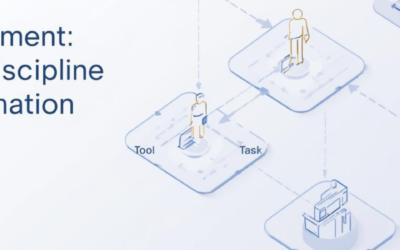
Agent Management: The Missing Discipline in AI Transformation
AI agents that can act require agent management: task design, tool permissions, audit trails, and accountability. Here is the operating model playbook.

The EU AI Act : From Logic to Operational Reality
Understand EU AI Act compliance for businesses in 2026. Deadlines, fines, high-risk systems and what companies must do before enforcement begins.