
Make organizational change stick with Versatile Consulting
Change Management Consulting Service
Versatile Consulting provides change management consulting for organizations navigating complex change: operating model transitions, restructurings, and AI adoption. We work senior-led and participative — aligning stakeholders, building internal change capability, and managing resistance — so the change your organization designed becomes the way it actually works.
When to bring in a change management consultant
Change management consulting is rarely the first call. It becomes urgent when the design work is done and adoption is not happening. Typical signals:
- The new model is approved, but nothing has changed. The new operating model is signed off, the org chart is updated — and six weeks later everyone works the way they always have.
- Earlier initiatives launched loudly and faded quietly. Kick-offs, town halls, a burst of energy — then the transformation stalled once leadership attention moved elsewhere.
- Change fatigue is setting in. After several reorganizations in a row, teams greet each new announcement with compliance at best and cynicism at worst.
- Middle managers are the bottleneck. They absorb pressure from above and resistance from below — and without support, they quietly dilute the change to protect their teams.
- Communication is one-way. People have been told about the change, but nobody owns it, and without feedback loops leadership discovers problems late.
- Old habits are back within months. The change held while the programme team was watching, then reverted the moment it dissolved.
If two or more of these sound familiar, the gap is not in the design — it is in the transition. That is the work change management does.
This is what we do
Versatile Consulting works across five areas of change management. Most engagements use all five, weighted to where the transition is weakest.
Stakeholder alignment
Change stalls when the people who must sponsor it are not visibly aligned. We map the stakeholders whose commitment the change depends on — executive sponsors, functional leaders, works councils, key influencers without formal authority — surface where their positions actually differ, and resolve those differences before they surface as passive resistance further down. Alignment here means a leadership group that gives the same answer when asked why the change is happening.
Communication architecture
Announcements are not communication. We build the structure that carries the change: what is said, by whom, through which channel, at what point, and — critically — how responses travel back up. Line managers get the arguments and answers they need to hold conversations with their own teams rather than forwarding a slide deck. Feedback loops are designed in, so leadership learns where the change is failing while there is still time to act.
Resistance management
Resistance is information, not obstruction. It usually signals a legitimate cost that the design overlooked: lost autonomy, unclear future roles, or a workload that nobody has removed. We work with the groups that resist to identify what is driving it, distinguish concerns that require a design change from those that require support, and address both openly. Resistance that is suppressed does not disappear — it reappears as slow adoption once attention moves on.
Change capability building
The objective is an organization that no longer needs us. We build internal capability — change leads, sponsor coaching, line-manager development — so the organization can run its next transition without external support. This is what makes change leadership consulting different from programme staffing: we transfer the method rather than performing it on your behalf.
Stakeholder alignment
Most transformations revert in the months after the programme closes. Embedding means changing what surrounds the new way of working: decision rights, meeting structures, metrics, incentives, and onboarding — so the new behaviour is the easiest one available. We plan the handover and the sustainment measures before go-live, not after.
Change management assumes a destination. If the future-state model itself is still undefined — capabilities, structure, decision rights, governance — that is design work, not transition work. See our target operating model design service.
Change also depends on who leads it. Transitions expose gaps in leadership capability and continuity. See leadership development and succession planning.
AI adoption is a change problem before it is a technology problem. If the question is how work itself gets redesigned around AI — which tasks move, who decides what, how human and machine work divide — that is operating model design. See our AI operating model design service.
How to choose a change management consulting firm
Change management consulting firms fall broadly into two models: large consultancies that deploy a delivery team against a methodology, and senior-led boutiques that engage a small number of experienced practitioners directly. Neither is better in the abstract. The right choice depends on the scale of the change, whether your organization needs delivery capacity or judgement, and whether you intend to retain the capability afterwards.
| Decision criterion | Large consultancy | Senior-led boutique |
|---|---|---|
| Who does the work | Partner scopes the engagement; a delivery team executes it. | The consultant who scoped the engagement is in the room throughout. |
| Delivery capacity | High. Can staff simultaneous workstreams across many sites at once. | Deliberately limited. Suited to focused transitions, not mass programme staffing. |
| Method | A proprietary framework applied consistently across clients. | A named methodology adapted to the organization’s context and constraints. |
| How change is designed | Typically designed centrally, then communicated and rolled out. | Designed with the people who will operate it, through participative sessions. |
| What remains afterwards | Documentation, tooling, and a trained programme office. | Internal change capability: change leads, sponsors, and line managers who can run the next transition. |
| Cost structure | Higher day rates and larger teams; cost scales with the size of the programme. | Fewer people at senior rates; cost scales with the duration of the engagement. |
| Best fit | Enterprise-wide programmes needing sustained delivery capacity you do not have internally. | Transitions where adoption, not resourcing, is the binding constraint. |
Our approach: participative change, not prescribed change
Most change management fails in the same place: a plan designed by a small group is handed to the people who have to live with it. Versatile Consulting works the other way round. The people affected by the change help design how it happens — which is slower to start and considerably faster to stick.
Whole Scale Change
Our practice is grounded in Whole Scale Change, a methodology for engaging large groups in designing their own transition rather than receiving it. Where conventional change management designs a plan in a small group and then communicates it outwards, Whole Scale Change puts the people affected by the change into the design itself.
In practice this means working sessions of between 40 and 200 people at a time — executives, line managers and the teams who will operate the new way of working, in the same room over one to two days. The groups work on the same questions in parallel, and what comes out of them changes the design rather than being collected as feedback. Objections surface where they can be resolved, instead of after go-live, where they cannot.
The trade-off is real: it takes more of your people’s time upfront than a conventionally communicated change. What it buys is an organization that can explain the change without us, because it wrote part of it.Read more about the Whole Scale Change approach.
Saket also delivers open Whole Scale Change training through Versatile Academy.
How an engagement runs
1. Read the ground. We establish where adoption is actually failing, which is rarely where the programme reports it. This means conversations with sponsors, line managers and the teams expected to work differently — including the ones who have already decided the change will not last. Deliverable: a change readiness picture, naming the specific groups, decisions and unresolved trade-offs that will determine whether the change holds.
2. Align the sponsors. Before anything is communicated more widely, the leadership group has to give the same answer to why the change is happening and who now decides what. Where their positions genuinely differ, we resolve it here rather than letting it surface as mixed messages later. Deliverable: an agreed leadership position and a communication architecture — what is said, by whom, through which channel, and how responses travel back.
3. Design the transition with the people in it. Using Whole Scale Change, the people who will operate the new way of working take part in designing how the organization gets there. Objections surface in the room, where some lead to genuine adjustments and the rest get answered. Deliverable: a transition plan built by the people who have to execute it, with the design changes their objections produced.
4. Embed and hand over. We change what surrounds the new behaviour — decision rights, metrics, meeting structures, onboarding — so the new way of working is the easiest one available, and we transfer the work to internal change leads. Deliverable: sustainment measures in place and a named group of internal change leads running the work without us.
Senior-led delivery
You work with the consultant who scoped the engagement. There is no handover to a junior delivery team after the proposal — the same person is in the room at kick-off, in the difficult sessions, and at the handover.
A couple of examples of our work:
Transforming ways of working across eight countries
Industry: Banking · Size: Largest Spanish bank · Impact: 7,000 people directly, 100,000+ indirectly · Footprint: 8 countries
The challenge. Digital banking development and release cycles were too slow for the pace the market demanded.
What we did. We started with 150 people on a ways-of-working change program inside digital banking, then designed the strategy and implementation to scale it across all eight countries of presence, with C-suite and board involvement in each one. The program included synchronized portfolio governance design and implementation across countries.
The results. A 73% reduction in time-to-market within the first four months. Subscriptions and revenue doubled within seven months. Customer satisfaction rose 80% within six months. The bank was rated the number one digital bank in Spain and Latin America, and held the “best digital bank” position in Spain and Mexico for multiple years. More than 7,000 employees were directly involved, with over 100,000 working under the resulting operating model.
Team: approx. 25 external + 100 internal.
Building an innovation culture from the ground up
Industry: HR and accounting software · Size: 2nd largest in its category · Impact: 4,000 people trained worldwide
The challenge. A traditional organization with little to no push for innovation, and a newly appointed Director of Innovation tasked with changing that.
What we did. We built and delivered a grassroots 10X innovation program: training — online and in person — open to anyone in the company who wanted it, rather than a top-down rollout to a selected few. As adoption spread, we designed a scaled version and a workshop for the C-suite and the board itself.
The results. More than 4,000 people trained across the globe in techniques including design thinking, design sprints and growth hacking. Multiple products and value streams began applying them, producing internal success stories in customer and employee experience. The approach was nominated at the #CMA2021Awards.
Team: 1 external + 5 internal.
About Versatile Consulting
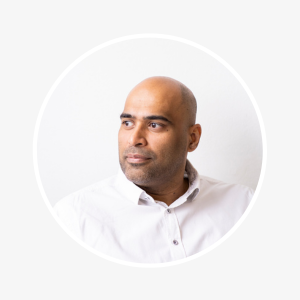
Saket Bivalkar
Managing Partner. Meet the Versatile Consulting team.
Saket Bivalkar is the founder and Managing Partner of Versatile Consulting and leads its change management work. He is a certified Whole Scale Change trainer and has delivered public training in the methodology internationally. Most of his change work begins after the design phase is over: a new operating model has been signed off, the structure has changed on paper, and the organization is still working the way it did before. He has run these transitions in telecom, FMCG, financial services y technology, in organizations spread across multiple countries and languages, where the change has to hold in each market and not only at headquarters.
Frequently asked questions
What does a change management consultant do?
A change management consultant works on the transition between a current and a future way of working — not on designing the future state itself. In practice that means aligning the leaders who must sponsor the change, building the communication structure that carries it, working with the groups that resist it, developing internal change capability, and putting in place the measures that keep the new way of working from reverting once the programme closes.
What is the difference between change management and target operating model design?
Target operating model design defines the destination: capabilities, structure, decision rights, and governance. Change management delivers the transition to it: how people move from the current way of working to the new one, and whether they stay there. The two are sequential but overlapping — change management started only after the design is signed off has already lost the opportunity to involve the people who will operate it. See our target operating model design service.
When should change management start in a transformation?
Change management should start during design, not after it. The people who will operate a new model are also the people whose adoption determines whether it works, and involving them while decisions are still open converts the objections that would otherwise appear after go-live. Engaging change management at the implementation stage is possible, but it becomes recovery work rather than transition work.
Why do change initiatives fail after launch?
Change initiatives usually revert because nothing around the new behaviour changed. Decision rights, metrics, meeting structures, incentives and onboarding continue to reward the old way of working, so once the programme team dissolves and leadership attention moves elsewhere, people return to what the system still makes easiest. The second common cause is that the change was designed by a small group and communicated outwards, leaving nobody outside that group with any ownership of it.
Can change management be done by an internal team?
Yes, and that is the objective. Internal teams have context and relationships that no external consultant can replicate. External support is worth bringing in when the change is contested at senior level and needs a neutral party, when previous initiatives have failed and credibility has to be rebuilt, or when the internal team has never run a transition of this scale before. In each case the aim is to leave the capability behind rather than to hold it.
How is change management different from project management?
Project management tracks whether the work was delivered: scope, timeline, budget, dependencies. Change management addresses whether people actually work differently as a result. A transformation can be delivered on time and on budget and still fail, because the deliverables shipped and the behaviour did not change. Most programmes have the first discipline and assume the second will follow.
Start a conversation about your change
If you have a transformation that people are not adopting, the first step is an exploration call. It is a conversation, not a pitch: we go through the change you are running, where it is stalling, and whether this is work we are the right firm for. If it isn’t, we will say so, and where we can we will point you elsewhere.