

SAKET BIVALKAR
Saket Bivalkar is the Managing Partner of Versatile Consulting, a boutique consultancy that designs operating models for multinationals. His work focuses on building models that hold across geographies while allowing for local adaptation. Recent engagements include 63-country and 42-country operating model transformations in regulated industries.
He is based in Spain and can be reached at saket@versatile.consulting.
Why Pharma Operating Models Break at the Border
The global-local tension in mid-sized pharmaceutical companies is not a change management problem. It is a design problem.
McKinsey recently surveyed 50 global life sciences leaders. 32 of them said they need a significantly different operating model. Nearly half said they need to abandon their traditional business model entirely to keep innovating. This should not surprise anyone who has worked inside a pharma company in the last five years.
What surprises me is what the conversation keeps missing. For a mid-sized pharma company running operations across 30 or 40 countries, the hard problem is not AI strategy or digital maturity. Those are real, but secondary. The hard problem is more basic: the operating model designed at headquarters does not work when it hits the ground in Sao Paulo, Osaka, or Istanbul.
I have spent the last decade redesigning operating models for multinationals. Most of that work has been outside pharma, in industries that share the same structural headaches: heavy regulation, global-local tension, compliance everywhere, and the permanent argument between “we need consistency” and “that won’t work here.” The failure patterns are almost identical across sectors. Pharma just has a few extra layers of complexity that make the problem worse.

How it breaks
Governance gets applied with a single brush.
Centralised governance makes obvious sense for regulatory compliance, pharmacovigilance, and quality. Nobody argues with that. The trouble starts when the same governance logic gets extended to commercial decisions, market access, or HR shared services. Suddenly local affiliates are waiting weeks for approvals on things that should take days. Some slow down and miss market windows. Others route around the system and create their own processes. Both outcomes are predictable, and both are the result of a governance model designed for one type of decision being applied to everything.
Roles overlap in ways the org chart never shows.
On paper, the split between global functions and local affiliates looks clean. In practice, they collide constantly. A global brand strategy says one thing. Local market access reality says something different. Who decides? Global workforce planning sets headcount targets. Local labour law makes those targets unworkable. Who adjusts? These conflicts don’t show up in the operating model design phase. They show up six months into implementation, when country managers start pushing back and HQ reads it as resistance.
Standardisation lands at the wrong altitude.
There is a real difference between what needs to be globally consistent, what should be set at regional level, and what should be left entirely to local teams. Most redesigns get this wrong in one direction or the other. Over-standardise and the model works perfectly in France but creates friction in every other market. Under-standardise and you end up with 35 slightly different versions of the same process, no ability to benchmark, and no way to move talent across geographies.
What tropicalization actually requires
Clients of mine use the word “tropicalization” when they describe what they want. It is a good word. But it gets misunderstood as translation plus local formatting. The real work is structural. It means making three design choices up front and being explicit about each one.
The backbone is what does not flex. Governance principles, decision-rights architecture, the performance measurement cadence, core process design. These are global. They are non-negotiable. If you cannot hold these consistent, you do not have an operating model. You have a collection of local practices with a shared letterhead.
The joints are where you build in controlled flexibility. Regulatory differences across markets, cultural norms around how decisions get made, local talent realities. A good model does not treat these as exceptions. It designs space for them from the start. When an adaptation is planned, it is governance. When it is unplanned, it is fragmentation.
The skin is everything that is genuinely local. Execution details, vendor relationships, day-to-day choices. These should not be governed from HQ at all. The common mistake is the opposite of what you’d expect: companies often try to control the skin centrally while leaving the joints undefined. They police the small things and leave the structural flexion points to chance.
Pharma’s compounding problem
Every multinational deals with global-local tension. Pharma has an additional layer that makes it structurally harder: regulatory divergence across markets. The same molecule can require a different operating model configuration in different countries because approval timelines, pricing and reimbursement frameworks, pharmacovigilance rules, and market access pathways are all different.
You cannot roll out a pharma operating model on a fixed schedule the way you might deploy a new ERP. Different markets will be at different stages of readiness. Some will be launching products that others won’t see for another two years. The model needs to accommodate that asynchrony by design, not treat it as an implementation problem to be managed through change management workshops.
And then there is the talent question. McKinsey’s data says less than a third of the leaders they surveyed believe their organisation has the capabilities needed for future portfolios. This matters because an operating model is only as good as the people inside it. If the new design requires skills your organisation does not have yet, you need a parallel capability-building track. Otherwise you are handing people a new structure and expecting them to operate it with old skills. That doesn’t work.
Test it before you deploy it
Something I have seen work well in other regulated industries, and that is starting to appear in pharma, is simulating the operating model before going live. Not academic modelling. Practical stress-testing.
What happens to decision speed if you centralise market access governance? What happens to compliance risk if you give more autonomy to local quality functions? What does the model do when you are launching a product in three markets while restructuring in a fourth? These are testable scenarios. Running them before deployment is cheaper than discovering the answers in a live environment across 35 countries.
Pharma already does this in R&D. Every clinical programme simulates outcomes before committing to full-scale trials. There is no reason the same logic should not apply to organisational design. The cost of getting it wrong across dozens of countries is not measured in consulting fees. It is measured in years.
Where to start
If you are a pharma leader thinking about operating model redesign, I would skip the methodology for now and start with three questions.
Where are your local affiliates already working around the global model? That is your real diagnostic. The workarounds are well known to country managers even when they are invisible at HQ. Map them and you have a precise picture of where the current model is failing.
Can you say in one sentence what must be globally consistent, and why? If the answer takes a paragraph, the backbone is not defined clearly enough. If different members of the leadership team give different answers, you have an alignment problem that no operating model can fix.
Are you designing something your people can actually run? The best operating model is the one that works with the capabilities you have while building toward the capabilities you need. A design that assumes readiness on day one is a design that will fail on day one.
The pharma companies that will pull ahead over the next decade won’t necessarily be the ones with the best pipelines or the deepest pockets. They will be the ones whose operating models let them move coherently across borders, adapt to local reality without losing discipline, and sustain the change after the people who designed it have moved on.
FAQs
Why do pharma operating models break down across affiliates and geographies
Pharma operating models commonly break down across affiliates because governance structures designed for GxP compliance and pharmacovigilance get extended to commercial, market access, and shared services decisions where they create bottlenecks. Decision rights between global functions and local affiliates are poorly defined, leading to conflicts between global brand strategy and local market access realities. Process standardisation is set at the wrong level, either too rigid for affiliate-level execution or too loose to support cross-market benchmarking, talent mobility, or consistent launch excellence.
How should mid-sized pharma companies adapt their target operating model for multi-country execution?
Mid-sized pharma companies should design their target operating model with three distinct layers. The global backbone covers non-negotiable elements: governance principles, decision-rights frameworks, performance cadence, and core process architecture across therapeutic areas. The adaptation layer builds in controlled flexibility for differences in regulatory approval timelines, pricing and reimbursement frameworks, local labour law, and affiliate maturity. The local execution layer covers market-specific tactics, vendor management, and day-to-day operational choices that affiliates manage autonomously. This layered approach prevents both HQ over-control and affiliate fragmentation.
Can you simulate a pharma operating model redesign before deployment across affiliates?
Yes. Organisational simulation allows pharma companies to stress-test operating model changes before live deployment across affiliates. Practical scenarios include modelling the impact of centralising market access governance on launch timelines, testing decision-speed trade-offs when consolidating medical affairs oversight, and evaluating how the model performs when concurrent product launches in multiple markets coincide with a restructuring. This mirrors the phase-gate logic pharma already applies in clinical development, reducing the risk and cost of discovering structural design flaws post-implementation across 30 or more countries.
What are the first steps in a pharmaceutical organisation design and operating model transformation?
The most effective starting point is a diagnostic of affiliate workarounds: where country and cluster teams are deviating from the global model reveals exactly where the current design is failing. Next, test executive alignment by asking whether the ELT can agree on what must be globally consistent across therapeutic areas and functions. Misalignment at this level cannot be solved by organisation design alone. Finally, assess capability readiness: if the target operating model requires competencies the organisation does not yet have in areas like data and analytics, omnichannel, or cross-functional pod-based working, a parallel capability-building programme must run alongside the structural change.
What is a Digital Twin of the Organisation (DTO) and how does it apply to agentic AI?
A DTO is a simulation model of an organization’s workflows, decision points, and human-agent interactions. Applied to agentic AI, it lets teams test human-agent handoffs, exception paths, escalation rules, and blast radius scenarios before agents are deployed in production — reducing the risk of discovering failure modes at scale.
AI Transformation in Telco – Operating Model or Technology?
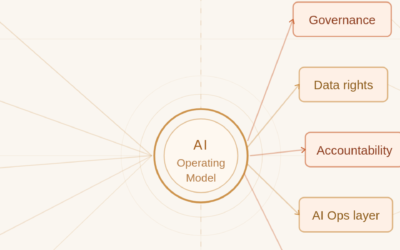
Most telco AI programmes do not stall because the technology fails. They stall because the operating model was never designed to absorb what the models produce. This article breaks down what the CTO needs to own, and the three operating model gaps that will block deployment regardless of how good the models are.

Why AI Use Cases Fail Without an Enterprise AI Operating Model.
Most AI programmes deliver isolated efficiency gains but fail to improve customer experience. The missing link is an enterprise AI operating model that connects internal activity chains to external outcomes.

Does AI Adoption Require Restructuring Your Organization?
AI adoption often does require restructuring, but not in the way most leaders think. The real shift is not org chart theatre. It is workflow redesign, clearer decision rights, stronger governance, and roles built for human and AI collaboration.